
© 2025 Mister Saad | All Rights Reserved

Dubai Marina

Mobile App MVP vs. Full App: What Should a Dubai Business Build First?
A Dubai business should develop a mobile app MVP first to test real user demand before spending significant capital on a full build. A full app is beneficial when your customers’ demands, business goals, required features, and technical requirements are already set. The guide below will help you decide which app version best supports your business goals and serves your target audience.
Author/Developer Experience:
Mister Saad offers his services in app planning and development, where he helps his clients to decide between a focused MVP or a full application according to their requirements, functionality, users, integrations, and growth plans. He offers MVP App Development in Dubai that focuses on core components for the user journey.
What is a Mobile App MVP
An MVP, or minimum viable product, is the first version of a fully functional application that is ready to use for delivering its primary services with essential features.
For example, a Dubai startup salon can develop an MVP for appointment bookings that might include:
● Customer registration
● Salon and service selection
● Appointment booking
● Booking confirmation
● Basic customer profile
● Simple business dashboard
The initial app might leave loyalty rewards, advanced promotions, multiple branches, in-app chat, sophisticated analytics, and automated marketing to be integrated in the future. It doesn’t mean you will get an unfinished app. By investing in Mobile App Development in Dubai, you can start with the features and integrations that actually fulfill your objectives and ignore those whose values have not been discovered yet.
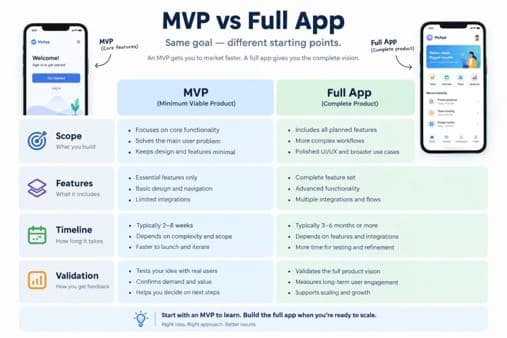
What’s the Difference Between an MVP and a Full App
The biggest difference between an MVP and a full app is about scope and certainty. If there is only one business focus, then an MVP is a nice idea, but if you have a broader and more developed business model, then you need a full application.
| Factor | Mobile App MVP | Full App |
|---|---|---|
| Main goal | Validate the core idea | Deliver the complete product |
| Features | Essential features only | Broad feature set |
| Development scope | Focused | Extensive |
| Initial investment | Lower relative scope | Higher |
| Launch approach | Earlier market feedback | More preparation before launch |
| User feedback | Used to shape future releases | Usually follows an established roadmap |
| Integrations | Only essential integrations | Multiple business systems may be included |
| User roles | Often limited | Can include customers, staff, vendors, administrators, and partners |
| Best suited to | New or unproven products | Validated products and established requirements |
Neither option is automatically a better one. An MVO can fail too if not technically well-planned, and launching a full app and investing time and budget is sometimes useless when you are not sure whether customers want that product or not.
When It Is Ideal to Develop an MVP first for a Dubai Business
An MVP app development is an ideal choice for Dubai businesses when the business is not aware of the market trends, consumer behaviour, pricing ranges, and product usage.
The business has a brand-new idea
If you have never offered your services to customers through an app before, it would certainly be difficult for you to know about the actual features customers use. For example, a fitness business in Dubai may consider that customers need the following:
● Class booking
● Trainer profiles
● Workout plans
● Nutrition tracking
● Community discussions
● Loyalty rewards
● In-app payments
Rather than immediately developing every feature, the business can start with class discovery, booking, payment, and basic customer accounts. When the business takes off, it will become easier to know which features the app needs now.
Customers’ demand is still ambiguous
Having a great application doesn’t mean that customers will download it immediately and will use it regularly. When starting with an MVP App Development in Dubai, ask the following questions:
● Will customers install the app?
● Will they complete registration?
● Will they use the core feature?
● Will they return?
● Will they pay through the app?
● Which parts of the experience cause users to stop?
Answering these questions are helpful than having assumptions.
You need market results before spreading
An MVP can provide you with an overview of its proposed results before you invest in something big. The process might look like this:
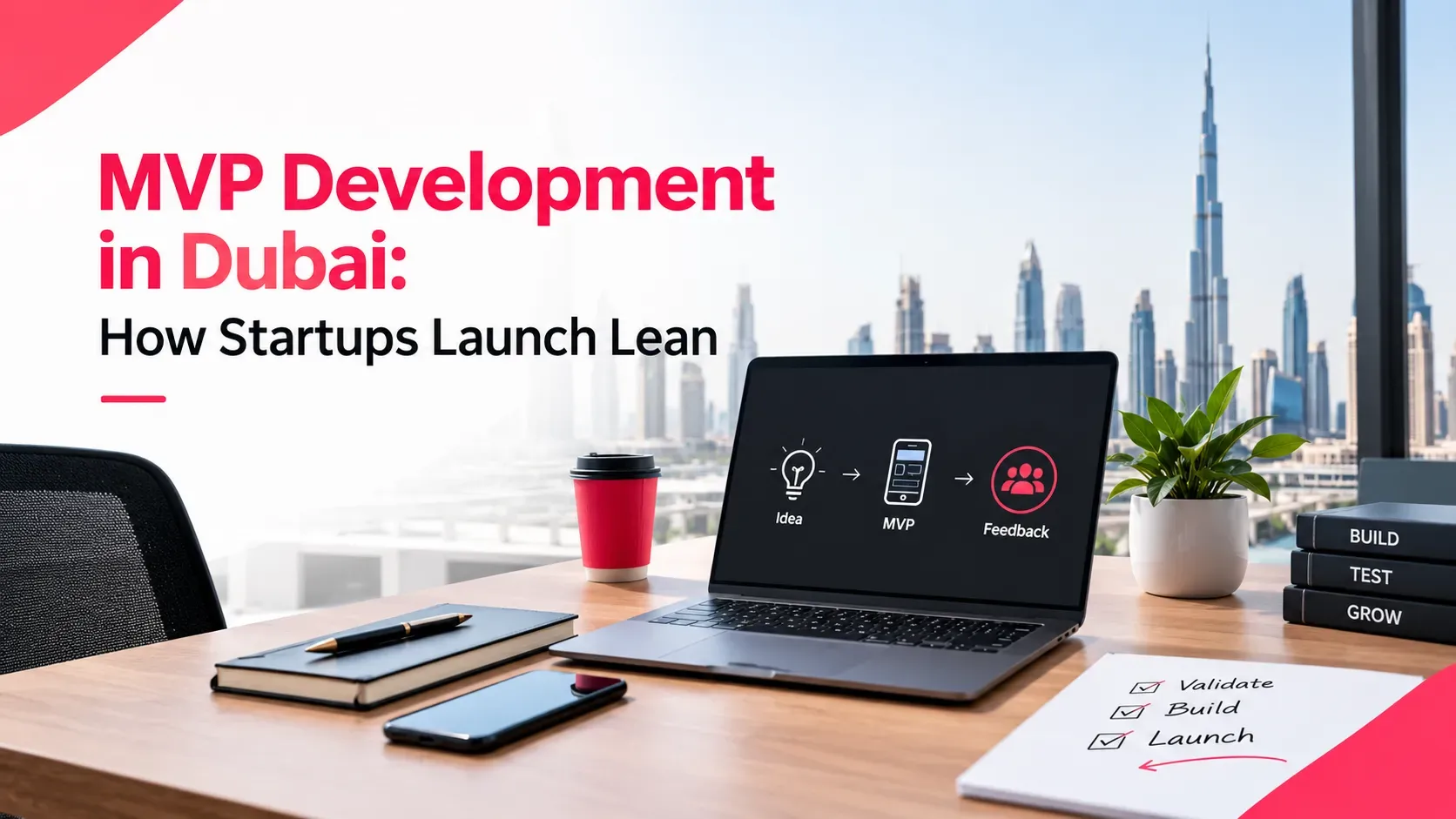
Idea → Prototype → MVP → User feedback → Version 2 → Full product
When It Is Ideal to Develop a Full App
Sometimes businesses know what they need and what type of features can make their organisation successful. Here, investing in a full app is an ideal decision.
Business requirements are already achieved
An established business knows about its services or products and how their customers are reacting towards it. For example, a company replacing an existing customer portal with a mobile application may already have:
● Established users
● Defined business processes
● Existing payment systems
● Known customer requirements
● Existing CRM or ERP infrastructure
● Clear operational workflows
The business model needs several systems
Some applications need interconnected components to function properly. A logistics platform, for example, may require customer accounts, driver functionality, location tracking, dispatching, notifications, payments, and an administrative system. If the business removes too many components, testing of the first version will become difficult.
Compliance or security is important
Some businesses need technical controls from scratch, such as financial services, healthcare, insurance, and applications handling sensitive information may require security, identity, data protection, access control, and operational requirements that cannot afford to be delayed. In this case, the development strategy should be aligned with the actual business and regulatory requirements instead of limiting the features to an MVP.
What Should an MVP Include
To build an MVP, it is better to focus on the user journey first rather than deciding on the feature list. Ask yourself what customers want when they visit your app and what actions they will take. Then develop an app according to that.
For example, if it's a real estate app, the journey would be: searching for properties, viewing their details, enquiring.
If it's a restaurant application, the customers would go through: browsing the menu, placing the order, receiving confirmation.
If the customer journey asks for those features, you must include them, such as authentication, payments, notifications, administration, analytics, and integrations.
What Can Be Added Later
According to the size and type of the business, the following features can be added later:
● Advanced loyalty systems
● Complex personalization
● Extensive reporting
● Social/community features
● Large promotional systems
● Extensive automation
● Non-essential integrations
● Multiple secondary user roles
● Advanced recommendation engines
Decide between what is optional and what is important for your business app. If the feature the customer is looking for is not available, then it was probably in the important categories.
What is the Cost Comparison Between Two Types of Apps
No fixed price can be quoted for both, as it depends on several factors:
● Number of platforms
● UI/UX complexity
● Number of screens
● Backend architecture
● User authentication
● Payment processing
● Maps and location services
● APIs and third-party integrations
● Admin dashboards
● Real-time functionality
● Notifications
● Security requirements
● Testing requirements
● Maintenance requirements
Every MVP is different from another one. A booking MVP with a simple customer journey is different from a marketplace that needs separate customer, provider, delivery, and administrative systems. You can’t compare both projects as an MVP. To invest in the right type of application, you need to identify your customer journey and then create a scope and request an estimate that is based on your actual requirements.
How Much Time Does an MVP App and Full App Take to Develop
An MVP app development takes less time compared to a full app because fewer features need to be designed, developed, installed, and tested. It doesn't mean ignoring important stages. The following features are still needed for a focused MVP:
● Product and requirements planning
● User-flow definition
● UI/UX design
● Development
● Backend and API work where required
● Testing and quality assurance
● Deployment
● Post-launch monitoring and improvements
A full application needs more time to develop because it adds more screens, user roles, integrations, workflows, edge cases, testing requirements, and operational systems. If you want to evaluate a detailed price estimation for both app development, see the Mobile App Development Timeline.
How an MVP Must Be Planned by Dubai Businesses
Businesses in Dubai must consider planning an MVP, in addition to considering what features to include. Local operating requirements matter equally and should be implemented from the beginning. They include:
Arabic and English Support
If the audience consists of Arabic speakers, then a right-to-left layout must be considered from the start of development rather than integrating it afterwards.
If the audience consists of Arabic speakers, then a right-to-left layout must be considered from the start of development rather than integrating it afterwards.
Local Payments
If the payment has to be processed through an app, identify the payment provider and technical requirements before development.
If the payment has to be processed through an app, identify the payment provider and technical requirements before development.
Location-Based Services
Businesses offering delivery, transport, real estate, field services, or location-based experiences may need maps, GPS, addresses, and real-time location functionality.
Businesses offering delivery, transport, real estate, field services, or location-based experiences may need maps, GPS, addresses, and real-time location functionality.
Business Integrations
A customer-facing app may need to communicate with an existing CRM, ERP, booking system, inventory platform, or other business software.
A customer-facing app may need to communicate with an existing CRM, ERP, booking system, inventory platform, or other business software.
Administrations
There should be someone in the business who will manage the information the business sees. The MVP admin area shouldn’t have to look for every report and automation. It should operate the core product effectively. These factors are especially important for App Development for Startups in Dubai who are planning to expand further.
There should be someone in the business who will manage the information the business sees. The MVP admin area shouldn’t have to look for every report and automation. It should operate the core product effectively. These factors are especially important for App Development for Startups in Dubai who are planning to expand further.
Practical Example: A Dubai Food Delivery Startup
A startup that wants to connect every customer with their respective restaurant has founders who initially decide to integrate:
● Customer app
● Restaurant app
● Driver app
● Loyalty programme
● Live chat
● Subscription plans
● Restaurant advertising
● AI recommendations
● Advanced analytics
● Referral programme
● Multiple payment options
But integrating all of these features at once can result in a big app project. A more focused MVP can involve:
Customer: browse, order, pay, then track.
Restaurant: receive, accept, update order.
Operations: manage restaurants, orders, delivery status.
When the restaurant starts to collect real customer data and orders, the next stage can be to expand it. Like this, the restaurant business can decide what to include in the app further and what the “full app” will result in.
What Common Mistakes to Avoid in Developing an MVP
Considering MVP as the cheap version of the full app
Developing an MVP doesn’t mean creating a cheap, low-quality app that doesn’t need to have essential features such as smooth navigation, fast loading, or correct product display. But it actually needs to be reliable to test customer response to reach full app.
Emphasizing the need to include everything
If you keep on adding features, it will not remain an MVP. Instead, focus on the most needed ones, such as:
Must-haves: needed for the core user journey
Navigation problems: If the app is not structured properly, the user would face a difficult time finding somewhere in the menu or moving through apps.
Should have: optional but not needed for the launch
Later: features that can be added later after initial validation.
Ignoring the future structure
It shouldn’t be developed carelessly. The development approach should consider how the app will grow and perform. If it doesn’t happen, the business has to reinvest.
Measuring the wrong things
MVP performance can’t be determined through downloads only. According to the type of product, the indicators can involve:
● Registration completion
● First successful transaction
● Repeat usage
● Booking completion
● Payment conversion
● Customer retention
● Feature usage
● Support requests
● Customer feedback
The measurements should directly answer the question the MVP was developed for.
Final Words
Considering MVP mobile app development is ideal because it provides better product decisions with real proof. Once the business is set with its goals, is clear about the user journey, and is getting useful results from the core concept, then it can shift to a full application to scale its successful product. Get started with MVP development, save your investment, and achieve desirable business results.
FAQ's
Can the MVP be considered the real mobile app?
+Is an MVP suitable for my Dubai startup?
+Can I transform an MVP into a full app?
+Is it necessary to launch an MVP on both iOS and Android?
+What benefits can I get from an MVP?
+






Leave a Reply